

Restorations
Implant Restoration
If you’ve lost a tooth, your dentist may have recommended getting a dental implant to fill the empty space and allow for optimal function of your teeth. The dental implant itself is only a replacement for the root of the lost tooth, so after the implant has been placed, you’ll still need to get a restoration, or replacement tooth. Implants provide a strong foundation for fixed (permanent) or removable replacement teeth that are made to match your natural teeth.
To make the new tooth or teeth, your dentist will make an impression of your existing teeth, creating a model of your bite. The new restoration, most typically a crown, will be based on this model so it will blend in perfectly with the rest of your teeth. The crown is then attached to the connector point (abutment) on your implant.
Replacing a lost tooth is essential to a healthy mouth and a healthy body. It will provide you with increased aesthetics of course, but will also improve your speech, ease of eating, and oral hygiene.
Dentures
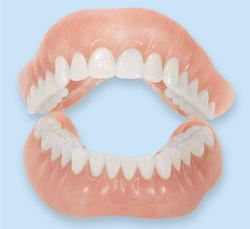
Dentistry is all about smiles, and having a confident, healthy, beautiful smile is important even for patients wearing dentures. Our practice provides personalized denture services that meet the needs and comfort levels of our patients. All of our patients are unique and we create one-of-a-kind dentures that feel good and look natural.
What are dentures?
Dentures are natural-looking replacement teeth that are removable. There are two types of dentures: full and partial.
- Full dentures are given to patients when all of the natural teeth have been removed. Conventional full dentures are placed after the gum tissue has healed, which can take several months. Immediate full dentures are placed immediately after the teeth have been removed and may require frequent adjustments during the first couple of months of use.
- Partial dentures are attached to a metal frame that is connected to your natural teeth and are used to fill in where permanent teeth have been removed. Partial dentures are considered a removable alternative to bridges.
How do I know if dentures are the right choice for me?
Dentures are not for everyone. If you're interested in learning more about dentures and want to know if they are the right choice for you, please schedule an appointment. Our team will be happy to answer any questions you might have, and can determine the best course of treatment for your ongoing dental health.
Inlays and Onlays
Inlays and onlays are a type of indirect restoration, where your dentist fabricates the restoration outside of your mouth and cements it into place. A direct restoration, most commonly fillings, are placed immediately into a prepared cavity in a single visit.
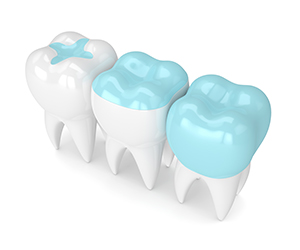
Inlays and onlays are used in molars or premolars, when the tooth has experienced too much damage to support a basic filling, but not so much damage that a crown is necessary. They can be made of gold, metal alloys, ceramics, or composites. An inlay is used when the cavity rests between the cusps, whereas an onlay covers one or more cusps, as well as the area in between. A crown replaces the entire outside area of the tooth above the gum line.
Indirect fillings generally require two or more visits. During the first visit, your dentist prepares the tooth and makes an impression of the area to be restored. Your dentist then places a temporary covering over the prepared tooth. The impression is sent to a dental laboratory, which creates the dental restoration. At the next appointment, we cement the restoration into the prepared cavity and adjust it as needed.
Full-Mouth Reconstruction
Full-mouth reconstruction, full-mouth rehabilitation, and full-mouth restoration are terms often used interchangeably to describe the process of rebuilding or restoring all of the teeth in both the upper and lower jaws simultaneously. Your dentist, who has years of experience working with the materials and procedures related to full-mouth reconstruction, will develop a plan that addresses all your needs and will leave you with a perfect smile, ideal bite, and optimal function.
You may be a candidate for full-mouth reconstruction if:
- Your teeth have been lost due to decay or trauma
- Your teeth have been injured or fractured
- Your teeth have become severely worn because of long-term acid erosion (from foods, beverages, or acid reflux)
- You have ongoing jaw, muscle, or headache pain related to your bite
The extent of your reconstruction will depend on the condition of your teeth. Your dentist may recommend crowns, bridges, veneers, or implants to restore your smile to its best possible condition. He or she will also address the state of your gum tissue, as the health of your gums may impact the type of restorations you receive.
Your treatment plan will entail a step-by-step process detailing all aspects of your reconstruction. The duration of your treatment will depend on the extent of work needed, but in the end it will all be worth it. Your teeth, mouth, and smile will be healthy and beautiful for the rest of your life.